

In the modern NFL, the salary cap is as strategic as any playbook. Teams constantly push money into the future, restructure contracts, and convert salaries into bonuses to maximize short-term championship windows. But eventually, the bill comes due.
When a player is released, traded, or retires before their contract voids naturally, the remaining prorated signing bonus and certain guarantees accelerate onto the salary cap as “dead money” – cap space devoted to a player no longer on the roster. Over the last several years, a wave of quarterback movement has produced the five largest dead cap hits in league history.
Here’s a look at the five biggest dead cap hits in NFL history – and the circumstances that made them so costly.
Top 5 Largets Dead Cap Hits in NFL History
- Tua Tagovailoa: $99 Million
- Russell Wilson: $85 Million
- Matt Ryan: $40.5 Million
- Aaron Rodgers: $40.3 Million
- Tom Brady: $35.1 Million
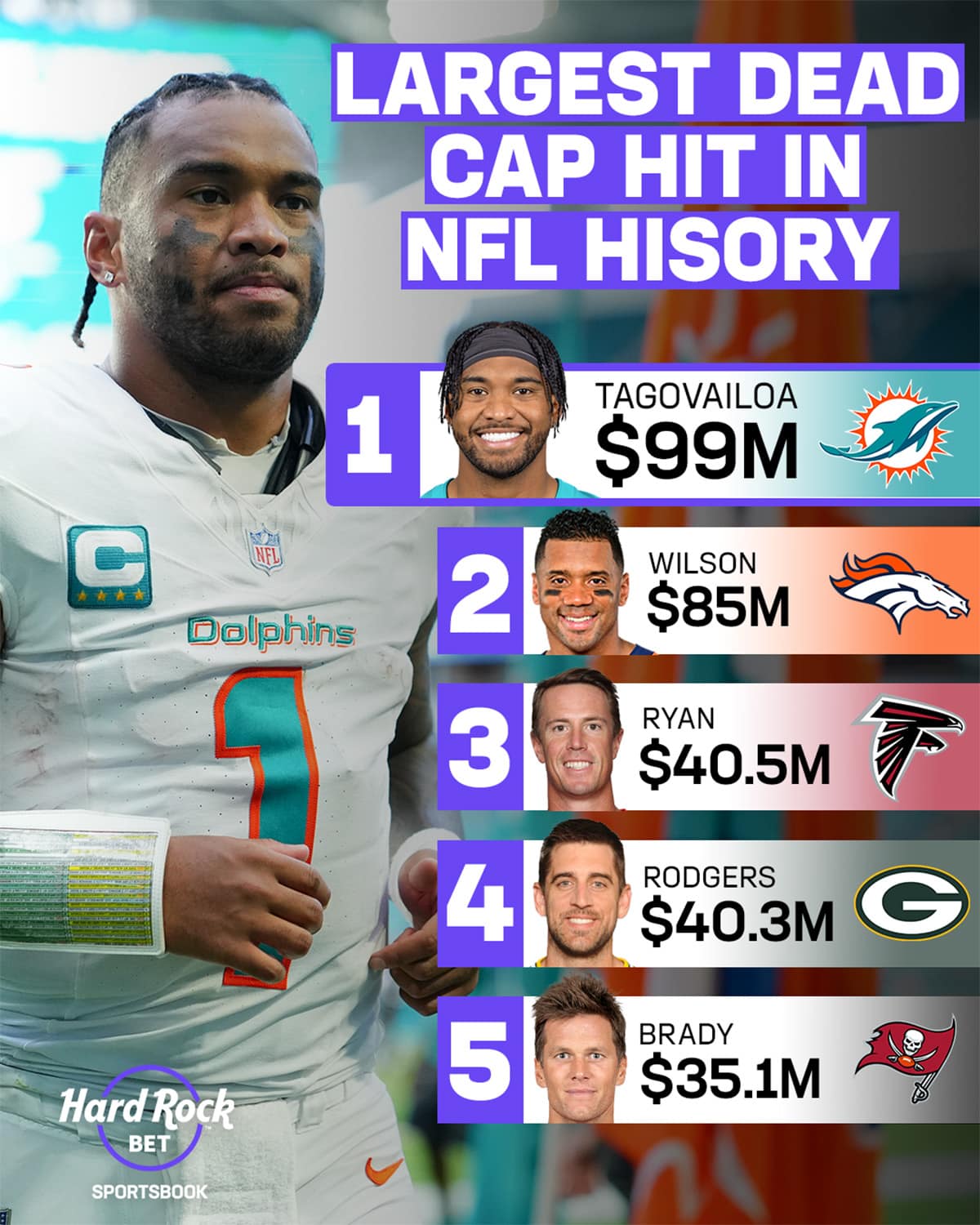

1. Tua Tagovailoa — $99 Million
The largest dead cap charge in NFL history now belongs to Tua Tagovailoa at a staggering $99 million.
Sources: The Dolphins are releasing QB Tua Tagovailoa with a post–June 1 designation.
By cutting Tagovailoa, Miami will take on an NFL-record $99 million in dead money, split over two years, but new GM Jon-Eric Sullivan and HC Jeff Hafley now get a fresh start at the quarterback… pic.twitter.com/521FwOj0MR
— Adam Schefter (@AdamSchefter) March 9, 2026
Tagovailoa earned a massive $212.4M extension after leading Miami’s high-powered offense under Mike McDaniel, throwing for more than 4,600 yards during the 2023 season and leading the team to the playoffs.
When Miami ultimately moved on this week – the structure of the deal created a cap detonation as the Dolphins will absorb nearly $100 million in dead cap.
The move underscored two realities of today’s NFL: franchise quarterbacks now command contracts north of $50 million per year, and if a team’s timeline shifts suddenly, the financial consequences can be historic.
Notably, the Dolphins’ Super Bowl odds remain unchanged after Tua’s release, currently sitting at 200-1 on Hard Rock Bet Sportsbook. The Arizona Cardinals, who announced they will release Kyler Murray this offseason (and will incur a $54 million dead cap hit of their own later this offseason), are the only team with longer odds to win it all (250-1).
2. Russell Wilson — $85 Million
Russell Wilson’s $85 million dead cap hit with the Denver Broncos is one of the most infamous quarterback contracts in recent memory.
Denver traded multiple first-round picks and players to Seattle in 2022 and immediately signed Wilson to a massive $242M extension before he even took a snap. The deal included heavy guarantees and significant signing bonus proration.
The partnership collapsed quickly. After a disastrous 2022 season and a rocky 2023 campaign, the Broncos decided to move on. Cutting Wilson triggered, at the time, the largest dead cap hit ever — approximately $85 million, spread across two seasons.
It also illustrated how ownership willingness to eat massive financial losses can accelerate organizational resets. The Broncos selected quarterback Bo Nix in the 2024 NFL Draft who took the team to the AFC Championship Game in just his second season.
3. Matt Ryan — $40.5 Million
Before quarterback contracts exploded past $50 million per year, Matt Ryan’s departure from Atlanta set the benchmark for dead money pain.
In 2022, the Falcons traded Ryan to the Indianapolis Colts. Once Atlanta pivoted away from Ryan – the franchise’s longtime cornerstone and former MVP – the move triggered $40.5 million in dead cap charges.
At the time, it was the largest single dead cap hit in league history. Ryan’s contract had been restructured multiple times to create cap space during Atlanta’s competitive window, pushing cap charges into future seasons. When the Falcons finally moved on, the remaining prorated money accelerated immediately.
The result was a financial reset year for Atlanta. The Falcons absorbed the pain in 2022, cleared future flexibility, and began a full-scale roster rebuild. Ryan’s dead cap hit became a blueprint example of how restructuring to chase contention can eventually lead to a painful but necessary reckoning.
4. Aaron Rodgers — $40.3 Million
Aaron Rodgers’ split from the Green Bay Packers in 2023 was years in the making.
After back-to-back MVP seasons in 2020 and 2021, Rodgers signed a lucrative $150M extension that included a massive signing bonus. The deal was designed to keep Green Bay competitive while maintaining short-term cap manageability.
When the Packers decided to transition to Jordan Love and traded Rodgers to the New York Jets, the remaining prorated bonuses accelerated onto Green Bay’s cap. The result: roughly $40 million in dead money.
Unlike some other entries on this list, the Rodgers dead cap hit was not the result of failure. It was a calculated pivot. Green Bay absorbed the hit in exchange for draft compensation and a clean transition to its next quarterback era. The Packers structured the trade in a way that consolidated much of the financial damage into a single season, prioritizing long-term clarity over prolonged cap strain.
5. Tom Brady — $35.1 Million
When Tom Brady retired (for good) after the 2022 season, the Tampa Bay Buccaneers were left with approximately $35.1 million in dead cap charges in 2023.
Brady’s contract had been intentionally structured to maximize Tampa Bay’s Super Bowl window. The Bucs had added void years to spread out signing bonuses and keep annual cap numbers lower during their championship push.
Those void years are designed to trigger once a contract ends – and when Brady retired, the remaining prorated bonus accelerated immediately. Tampa Bay effectively paid for its Super Bowl LV title with a significant cap hangover.
Unlike some of the other names on this list, Brady’s dead cap hit was widely accepted as the cost of doing business. The Buccaneers won a championship and remained competitive for multiple seasons. The financial aftershock was the predictable downside of pushing chips to the center of the table.
The Bucs didn’t slow down, either. They signed Baker Mayfield, and won the NFC South in both 2023 and 2024.
Dead Cap as a Strategic Tool
What’s striking about this list is that not all dead cap hits signal disaster.
- Denver’s Russell Wilson move was widely viewed as a failure of evaluation and fit, but the Broncos were a game away from the Super Bowl just two seasons later.
- Atlanta’s Matt Ryan exit marked a rebuild.
- Green Bay’s Rodgers transition was strategic.
- Tampa Bay’s Brady charge was the final invoice on a championship.
- Miami’s Tua situation reflects the modern risks of mega-extensions.
Dead money is no longer just a mistake – it’s often part of an intentional reset strategy.
As quarterback contracts continue climbing and teams manipulate cap structures more creatively, the $99 million benchmark won’t stand for long. In today’s NFL, financial risk is simply part of chasing elite quarterback play.
And when the gamble doesn’t work – or when an era ends – the cap always collects.
Offered by the Seminole Tribe of Florida in FL. Offered by Seminole Hard Rock Digital, LLC, in all other states. Must be 21+ and physically present in AZ, CO, FL, IL, IN, MI, NJ, OH, TN or VA to play. Terms and conditions apply. Concerned about gambling? In FL, call 1-833-PLAYWISE. In IN, if you or someone you know has a gambling problem and wants help, call 1-800-9-WITH-IT. In AZ, OH, & VA, call 1-800-MY-RESET.
GAMBLING PROBLEM? CALL 1‑800‑GAMBLER (CO, IL, MI, NJ, TN)


