


Christmas Day may still conjure images of family gatherings, comfort food, and long-standing festive rituals, but our Christmas 2025 survey of 2,000 Americans reveals just how dramatically the holiday is changing. The rhythm of the day is being shaped not by tradition, but by sport. From rearranging meal times to fit the NFL Christmas games or the NBA Christmas Day schedule, to navigating family disputes sparked by fierce sports rivalry drama, the season is evolving with NFL fandom into a celebration where game time is becoming just as important as turkey time.
Alongside this cultural shift, new pressures are emerging. Rising holiday hosting stress, concerns around holiday expenses in 2025, and even light-hearted tensions over the worst Christmas gifts are influencing how households prepare for and experience the season. As Americans’ Christmas habits adapt to balance family expectations, entertainment, and Yuletide stress, a unique picture of modern festive life is taking shape.
Our Christmas 2025 survey uncovers the emotional, financial, and social forces redefining the holidays, from changing viewing habits to the growing dominance of Christmas Day games in homes across the nation. To understand these evolving behaviors, we surveyed 2,000 American adults aged 21 and above who celebrate Christmas. We captured genuine attitudes around spending, traditions, sports consumption, gift-giving, and festive pressures.
1 in 4 Americans plan their Christmas Day around sports
A striking 24% of Americans say they now plan their entire Christmas Day schedule around a sports game, which is a clear sign of how central live sport has become to the modern holiday. For many households, the timing of presents, meals, and visits now depends on when the NFL Christmas games kick off or which matchups dominate the NBA Christmas Day schedule.
Younger adults are the most likely to build the day around a game, but the trend spans all age groups, fuelled by growing Christmas sports viewership and longstanding holiday sports traditions in the USA. In some families, it’s a fun, shared ritual; in others, it’s the source of playful tension as festive plans bend to sporting loyalties. Either way, sport isn’t just part of Christmas anymore; for millions, it helps shape it.
This perhaps isn’t surprising when you factor in the NFL games taking place on Christmas Day, such as the Dallas Cowboys at Washington Commanders (Netflix), Detroit Lions at Minnesota Vikings (Netflix), and Denver Broncos at Kansas City Chiefs (Prime Video).
We then have the NBA Christmas Day schedule: Cleveland Cavaliers vs New York Knicks, San Antonio Spurs vs Oklahoma City Thunder, Dallas Mavericks vs Golden State Warriors, Houston Rockets vs Los Angeles Lakers, and Minnesota Timberwolves vs Denver Nuggets, all on ABC and ESPN.
Which sports league do you most associate with Christmas Day games?
When asked which league they most strongly associate with Christmas Day sports, 37% of respondents picked the NFL, compared with 13% who chose the NBA. This gap highlights a clear cultural shift: what was once an NBA-dominated holiday is increasingly becoming an NFL-led viewing environment.
Recent reporting has shown how the NFL has strategically expanded into Christmas Day scheduling, including high-profile streaming partnerships and marquee matchups designed to dominate the holiday audience. At the same time, the NBA has continued to invest in its traditional Christmas slate and has recently seen its strongest Christmas viewership in years. And yet, overall NBA viewing numbers still tend to fall short of the NFL’s, reflecting the league’s growing pull over the festive period.
The result is an unmistakable trend: for many Americans, Christmas Day games now mean NFL first. The holiday’s sporting identity is shifting, and the NFL is firmly taking the lead.
Would you tell a related child that Santa isn’t real if it guaranteed your favorite team a championship?
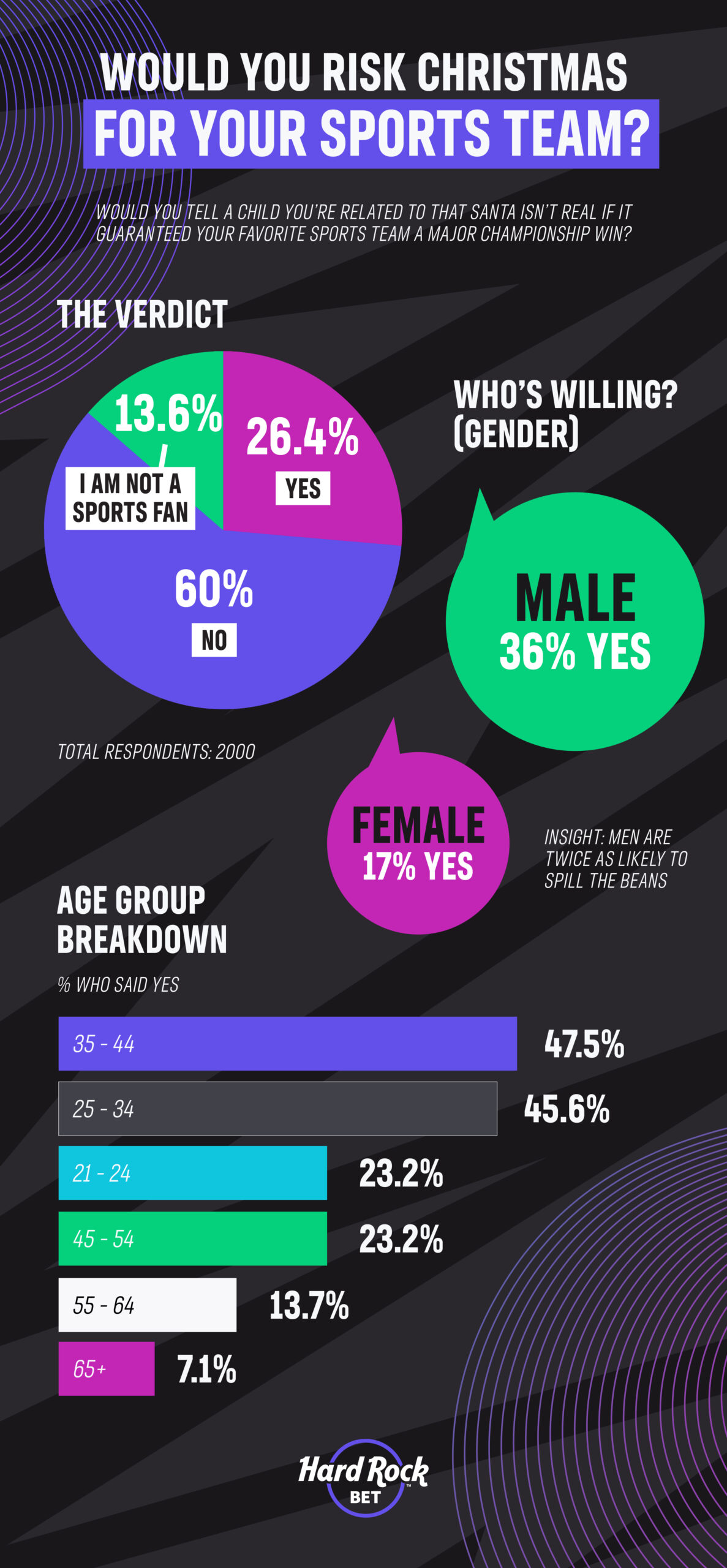
Twenty-six percent of Americans say they would reveal the truth about Santa if it guaranteed their favorite team a championship.
In other words, more than one in four people would knowingly “ruin Christmas” for sporting glory.
The divide becomes even sharper when we break the data down. The gender split is striking, as 36% of men admit they would spill the secret, compared with just 17% of women, highlighting how competitive fandom can override festive sentiment for a sizeable share of male supporters.
Age also plays a major role. Those in the 25-44 bracket are the most likely to make the sacrifice, with a remarkable 47% saying they would tell a related child that Santa isn’t real if it meant securing a championship, which is the highest of any age group. Younger adults appear to prioritize sporting success over seasonal magic far more than older generations.
Together, these numbers reveal just how deeply sports loyalty runs during the holidays. For millions of Americans, the joy of a long-awaited title might just outweigh the joy of Christmas morning.
What are the top causes of Christmas Day drama in your house?
While the Santa-for-a-championship dilemma could easily spark festive stress, the everyday causes of Christmas conflict are far more varied. According to our findings, 17% of Americans say sports rivalries are the biggest source of Christmas Day arguments in their homes, showing just how influential game-day loyalties have become during the holidays.
But sporting clashes are only one piece of the puzzle. Household pressures such as Christmas family arguments, holiday hosting stress, and disagreements over festive spending continue to shape the emotional landscape of the day. From guests arriving late to debates over the remote control, Christmas drama reflects both longstanding family patterns and the growing dominance of sport in the modern festive routine.
Holiday pressures and rising festive stress
Christmas may be a season of joy, but for many Americans, the strain is becoming harder to ignore. Nearly 48% say the holiday feels more stressful than in previous years, driven by a combination of hosting demands, rising costs, and growing expectations around creating a “perfect” festive experience. These pressures form the backdrop for much of the tension and emotional flare-ups that accompany the day.
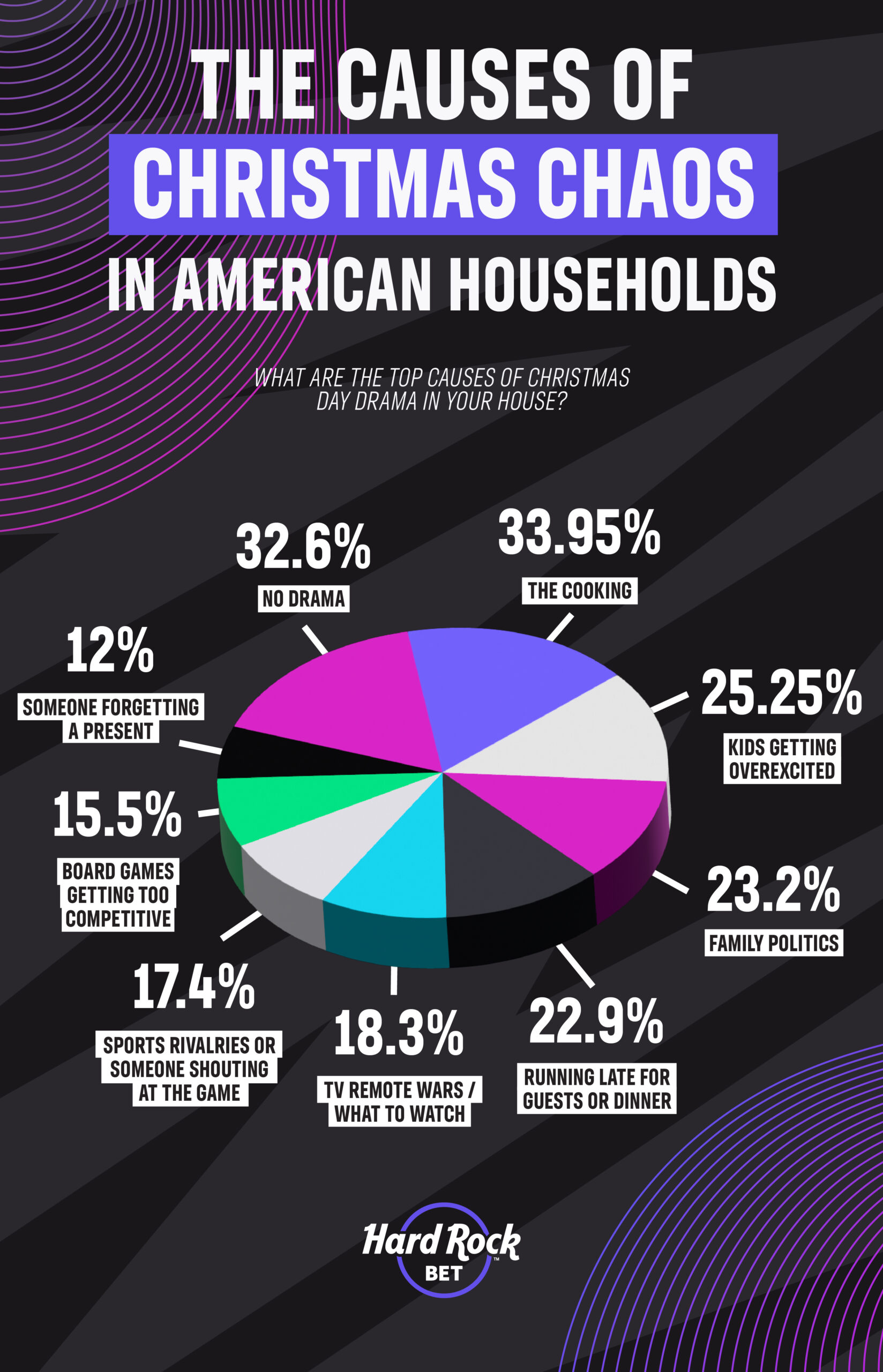
What are the top causes of Christmas Day drama in your house?
When asked about the biggest contributors to Christmas Day stress, people highlighted familiar flashpoints: disagreements involving children, challenging family dynamics, and the responsibility of hosting.
Cooking topped the list as the biggest cause of stress, cited by 34% of respondents, which reinforces how the kitchen becomes one of the most high-pressure environments of the holiday.
If you’re hosting over Christmas, would you expect guests to contribute to the cost?
Most Americans (67%) don’t ask guests to contribute financially toward Christmas gatherings. Of those who do, the average request is $19.44 per person. Age significantly shapes this expectation, as adults aged 35-44 ask the most at $22.17, while those aged 55-64 ask the least at $13.60, reflecting generational differences in attitudes toward shared hosting costs.
What time do you have your first drink on Christmas Day?
For those who drink alcohol, this was a light-hearted but revealing insight. The most common time for a first Christmas drink is 12pm-2pm (22%), hinting that celebrations (and stress relief) begin earlier for many households. Younger adults are more likely to pour their first drink before noon, while older groups tend to wait until later in the afternoon.
What are the biggest Christmas party “icks” at work?
Workplace festivities aren’t immune to festive frustrations. On the topic of drinking, the top “ick” is someone getting too drunk (29%), reflecting discomfort around blurred personal boundaries at office parties. Secret Santa follows at 17%, showing how even small workplace traditions can divide opinion.
How bothered would you be if your office held a Secret Santa this year?
Attitudes toward Secret Santa vary dramatically. 17% of people say they couldn’t care less if their workplace held one, while 14% are genuinely excited. This uncovers a mix of festive enthusiasm and seasonal indifference across American offices.
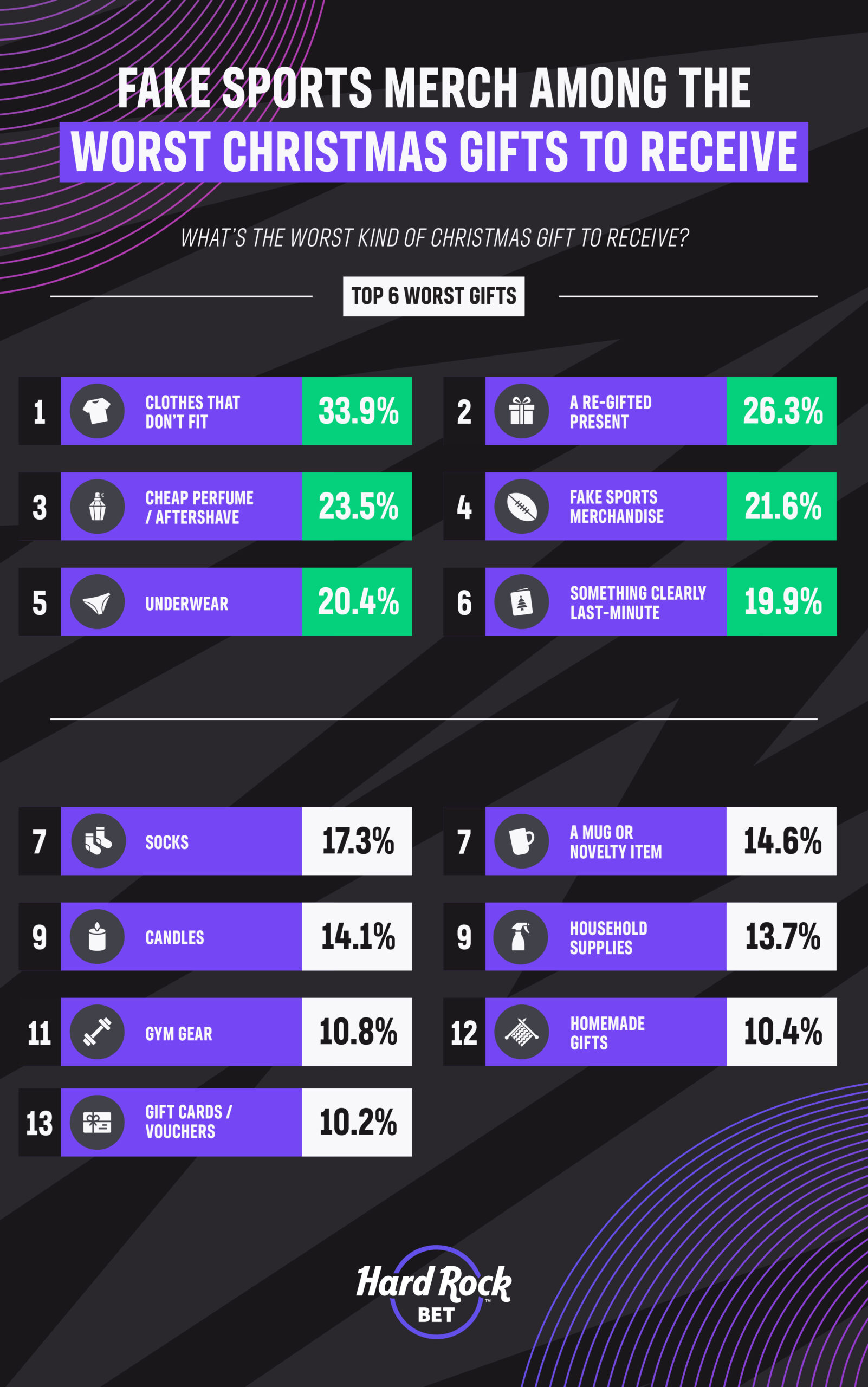
What’s the worst kind of Christmas gift to receive?
Opinions on bad gifts vary sharply by age. Younger adults (21–34) are particularly disappointed by cheap perfume and counterfeit sports merchandise, with 22% naming fake sports gear as one of the worst possible presents. This aligns closely with Gen Z’s strong attachment to their favorite teams, as highlighted in our recent report: How NFL Fandom Is Evolving Amongst Younger Generations. Older groups (35+) are more annoyed by last-minute gifts and re-gifting, favoring thoughtfulness over novelty.
Additionally, in a festive twist, socks are no longer the worst gift to receive. Rising costs and a renewed appreciation for practicality mean they’ve transitioned from an unwanted stocking filler to a genuinely welcome surprise.
This is solid proof that even Christmas clichés can evolve.
We wish you a sports-filled Christmas
As Christmas 2025 unfolds, it’s clear that festive traditions across the U.S. are shifting. With the growing dominance of NFL vs NBA Christmas viewership and the rising pressures that come with hosting, Americans are reaffirming what the holiday looks like. Gift-giving habits are also evolving, with younger generations particularly sensitive to holiday gift fails and the authenticity of what lands under the tree.
Together, these insights show a holiday season increasingly shaped by sport, stress, and changing expectations. However, they also show one defined by humor, resilience, and the desire to make Christmas meaningful in new ways. Whatever you’re planning for Christmas Day, make sure you visit our sportsbook for all your festive game-day odds and holiday showdowns.
Methodology
To understand how Christmas behaviors are shifting across America, we surveyed 2,000 U.S. adults aged 21+ who celebrate Christmas, conducted between November 19-25, 2025.
The survey explored changing habits around spending, family traditions, sports consumption, gifting, and festive pressures. By capturing real attitudes and lived experiences from people across the country, we were able to uncover meaningful trends shaping how Christmas is celebrated today.
Offered by the Seminole Tribe of Florida in FL. Offered by Seminole Hard Rock Digital, LLC, in all other states. Must be 21+ and physically present in AZ, CO, FL, IL, IN, MI, NJ, OH, TN or VA to play. Terms and conditions apply. Concerned about your gambling? In FL, call or text 1-833-PLAYWISE. In IN, if you or someone you know has a gambling problem and wants help, call 1-800-9-WITH-IT. In AZ and OH, call 1-800-MY-RESET.
GAMBLING PROBLEM? CALL 1‑800‑GAMBLER (CO, IL, MI, NJ, TN, VA)